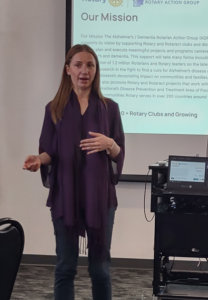
Art introduced Julie Rogers, Community Engagement Manager with the New Mexico Alzheimer’s Assoc. She pointed out a flyer on each table about an upcoming event, a
community forum shared with Aging and Long Term Services to help them understand how they can better serve the community. She pointed out that Rotary has a national partnership
with the National Alzheimer’s Assn. She is speaking at various clubs to educate people about what is Alzheimer’s, what is dementia and what the Association's role is. The mission of the Association is to eliminate Alzheimer’s disease, and they work toward that goal by funding research. Currently
the Association has $430 million placed with 1,100+ projects in 56 countries. They lead the way in seeking to eliminate Alzheimer’s and all other forms of dementia by accelerating global research, driving
risk reduction, early detection, and while waiting for a cure, making sure that quality care is provided to families dealing with such diagnoses through support groups like the one in
Silver City. She noted some facts about Alzheimer’s: 1 in 3 seniors dies with some type of dementia. Alzheimer’s kills more people than breast cancer and prostrate cancer combined but
currently receives less research funding. Dementia is an umbrella term for a cluster of symptoms. It is a term for cognitive changes
including memory and behavioral changes. There are many potential causes for dementia. Warning signs include memory loss that impacts your ability to go about your day to day functions,
decreased or poor judgment, sudden behavior changes, confusion with time or place. Non-modifiable risk factors are factors that increase your risk for getting dementia and cannot be
changed such as age, genetics, race, ethnicity. Modifiable factors are protecting against brain injury by wearing a helmet, taking care of your cardiovascular health, getting enough sleep,
eating a good diet avoiding highly processed foods, social engagement. Women are more likely to get Alzheimer’s than men. In addition, Black Americans and Hispanic Americans are more likely to get the disease and more likely to be delayed in getting treatment. There is no one test that can definitively diagnose Alzheimer’s. A physical exam is given first, then a neurological exam followed by cognitive testing. She displayed a chart that showed various treatment medications which the Alzheimer’s Association helped bring to market. Some newer medications, Leqembi and Kisunla help slow down progression for up to five
years but only for early diagnosis.

.png)